Saturday, 26 September 2015

फफूंद

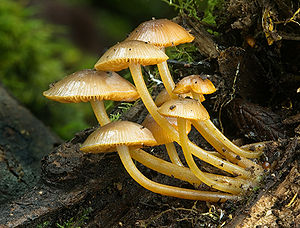
फफूंद या कवक एक प्रकार के पौधे हैं जो अपना भोजन सड़े गले म्रृत कार्बनिक पदार्थों से प्राप्त करते हैं। ये संसार के प्रारंभ से ही जगत में उपस्थित हैं। इनका सबसे बडा लाभ इनका संसार मे अपमार्जक के रूप में कार्य करना है। इनके द्वारा जगत में से कचरा हटा दिया जाता है।
आर्मिलेरिया ओस्टोयी" नामक कवक
कवक (फंगस, Fungus) जीवों का एक विशाल समुदाय है जिसे साधारणतया वनस्पतियों में वर्गीकृत किया जाता है। इस वर्ग के सदस्य पर्णहरिम (chlorophyll) रहित होते हैं और इनमें प्रजनन बीजाणुओं (spore) द्वारा होता है। ये सभी सूकाय (thalloid) वनस्पतियाँ हैं, अर्थात् इनके शरीर के ऊतकों (tissues) में कोई भेदकरण नहीं होता; दूसरे शब्दों में, इनमें जड़, तना और पत्तियाँ नहीं होतीं तथा इनमें अधिक प्रगतिशील पौधों की भाँति संवहनीयतंत्र (vascular system) नहीं होता। पहले इस प्रकार के सभी जीव एक ही वर्ग कवक के अंतर्गत परिगाणित होते थे, परंतु अब वनस्पति विज्ञानविदों ने कवक वर्ग के अतिरिक्त दो अन्य वर्गों की स्थापना की है जिनमें क्रमानुसार जीवाणु (bacteria) और श्लेष्मोर्णिका (slime mold) हैं। जीवाणु एककोशीय होते हैं जिनमें प्रारूपिक नाभिक (typical nucleus) नहीं होता तथा श्लेष्मोर्णिक की बनावट और पोषाहार (, nutrition) जंतुओं की भाँति होता है। कवक अध्ययन के विज्ञान को कवक विज्ञान (mycology) कहते हैं।
कुछ लोगों का मत है कि कवक की उत्पत्ति शैवाल (algae) में पर्णहरिम की हानि होने से हुई है। यदि वास्तव में ऐसा हुआ है तो कवक को पादप सृष्टि (Plant kingdom) में रखना उचित ही है। दूसरे लोगों का विश्वास है कि इनकी उत्पत्ति रंगहीन कशाभ (flagellata) या प्रजीवा (protozoa) से हुई है जो सदा से ही पर्णहरिम रहित थे। इस विचारधारा के अनुसार इन्हें वानस्पतिक सृष्टि में न रखकर एक पृथक सृष्टि में वर्गीकृत किया जाना चाहिए।
वास्तविक कवक के अंतर्गत कुछ ऐसी परिचित वस्तुएँ आती हैं, जैसे गुँधे हुए आटे (dough) से पावरोटी बनाने में सहायक एककोशीय खमीर (yeast), बासी रोटियों पर रूई की भाँति उगा फफूँद, चर्म को मलिन करनेवाले दाद के कीटाणु, फसल के नाशकारी रतुआ तथा कंडुवा (rust and smut) और खाने योग्य एव विषैली कुकुरमुत्ते या खुंभियाँ (mushrooms)।

रहन-सहन और वितरण

कवक की एक प्रजाति़
कवक की जातियों की संख्या लगभग 80 से 90 हजार तक है। संभवत: कवक सबसे अधिक व्यापक हैं। जलीय कवक में एकलाया (Achlaya), सैप्रोलेग्निया (Saprolegnia), मिट्टी में पाए जानेवाले म्यूकर (Mucor), पेनिसिलियम (Penicillium), एस्परजिलस (Aspergillus), फ़्यूज़ेरियम (Fusarium) आदि; लकड़ी पर पाए जानेवाले मेरूलियस लैक्रिमैंस (Merulius lachrymans); गोबर पर उगनेवाले पाइलोबोलस (Pilobolus) तथा सॉरडेरिया (Sordaria); वसा में उगनेवाले यूरोटियम (Eurotium) और पेनिसिलियम की जातियाँ हैं। ये वायु तथा अन्य जीवों के शरीर के भीतर या उनके ऊपर भी पाए जाते हैं। वास्तव में विश्व के उन सभी स्थानों में कवक की उत्पत्ति हो सकती है जहाँ कहीं भी इन्हें कार्बनिक यौगिक की प्राप्ति हो सके। कुछ कवक तो लाइकेन (lichen) की संरचना में भाग लेते हैं जो कड़ी चट्टानों पर, सूखे स्थान में तथा पर्याप्त ऊँचे ताप में उगते हैं, जहाँ साधारणतया कोई भी अन्य जीव नहीं रह सकता।
कवक की अधिकाधिक वृद्धि विशेष रूप से आर्द्र परिस्थितियों में, अँधेरे में या मंदप्रकाश में होती है। इसीलिए छत्रक अधिक संख्या में आर्द्र और उष्ण तापवाले जंगलों में उगते हैं।
वानस्पतिक शरीर की संरचना

कुछ एककोशिकीय जातियों, उदाहरणार्थ खमीर, के अतिरिक्त अन्य सभी जातियों का शरीर कोशिकामय होता है, जो सूक्ष्मदर्शीय ((माइक्रोस्कोपिक)) रेशों से निर्मित होता है और जिससे प्रत्येक दिशा में शाखाएँ निकलकर जीवाधार (substratum) के ऊपर या भीतर फैली रहती हैं। प्रत्येक रेशे को कवकतंतु (hypha) कहा जाता है और इन कवकतंतुओं के समूह को कवकजाल (mycelium) कहते हैं। प्रत्येक कवकतंतु एक पतली, पारदर्शी नलीय दीवार का बना होता है जिसमें जीवद्रव्य का एक स्तर होता है या जो जीवद्रव्य से पूर्णतया भरा होता है। ये शाखी या अशाखी रहते हैं और इनकी मोटाई 0.5 माइक्रान से लेकर 100 माइक्रान तक होती है (1 माइक्रान = एक मिलीमीटर का हजारवाँ भाग)।
जीवद्रव्य या तो अटूट पूरे कवकतंतु में फैला रहता है जिसमें नाभिक (nucleus) बिना किसी निश्चित व्यवस्था के बिखरे रहते हैं, अन्यथा कवकतंतु दीवारों का पट (septum) द्वारा विभाजित रहते हैं जिससे संरचना बहुकोशिकीय होती है। पहली अवस्था को बहुनाभिक (coenocytic) तथा दूसरी को पटयुक्त (septate) अवस्था कहते हैं। प्रत्येक कोशिका में एक, दो या अधिक नाभिक हो सकते हैं।
अधिकांश कवक के तंतु रंगहीन होते हैं, किंतु कुछ में ये विभिन्न रंगों से रँगे होते हैं।
साधारण कवक का शरीर ढीले कवकतंतुओं से निर्मित होता है किंतु कुछ उच्च कवकों के जीवनवृत्त की कुछ अवस्थाओं में उनसे कवकजाल घने होकर सघन ऊतक बनाते हैं जिसे संजीवितक (plectenchyma) और कूटजीवितक (preudoparenchyma)।
दीर्घितक ढीला ऊतक होता है, जिसमें प्रत्येक कवकतंतु अपना अपनत्व बनाए रखता है। कूटजीवितक में सूत्र काफी घने होते हैं तथा वे अपना ऐकात्म्य खो बैठते हैं और काटने पर उच्चवर्गीय पौधों के जीवितक कोशों (Parenchyma cells) के समान दिखाई पड़ते हैं। इन ऊतकों से विभिन्न प्रकार के वानस्पतिक और प्रजनन विन्यास (reproductive structure) का निर्माण होता है।
कवक की बनावट चाहे कितनी ही जटिल क्यों न हो, पर वे सभी कवकतंतुओं द्वारा ही निर्मित होते हैं। ये तंतु इतने सघन होते हैं कि वे ऊतक के रूप में प्रतीत होते हैं, किंतु कवकों में कभी भी वास्तविक ऊतक नहीं होता।

कोशिकाभित्ति (cell wall) की रासायनिक संरचना एवं कोशिका विज्ञान (cytology)

कुछ जातियों को छोड़कर कवकों की कोशिकाभित्तियों की रासायनिक व्याकृतियाँ (chemical composition) विभिन्न जातियों में भिन्न-भिन्न होती हैं। कुछ जातियों की कोशिकाभित्तियों में सेलुलोस या एक विशेष प्रकार का कवक सेल्यूलोस पाया जाता है तथा अन्य जातियों में काइटिन (chitin) कोशिकाभित्ति के निर्माण के लिए मुख्य रूप से उत्तरदायी होता हैं। कई कवकों में कैलोस (callose) तथा अन्य कार्बनिक पदार्थ भी कोशिकाभित्ति में पाए गए हैं।
कवकतंतु में नाभिक के अतिरिक्त कोशिकाद्रव्य (cytoplasm) तैलविंदु तथा अन्य पदार्थ उपस्थित रहते हैं, उदाहरणार्थ कैल्सियम ऑक्सलेट, (calcium oxalate) के रवे, प्रोटीन कण इत्यादि। प्रत्येक जाति में प्रोटोप्लास्ट (protoplast) हरिमकणक (chloroplast) रहित होता है। यद्यपि कोशिकाओं में स्टार्च का अभाव होता है, तथापि एक दूसरा जटिल पौलिसैकेराइड ग्लाईकोजन (polysaccharide glycogen) पाया जाता है।

पोषाहार (nutrition)

पर्णहरिम की अनुपस्थिति के कारण कवक कार्बन डाइ-ऑक्साइड और जल द्वारा कार्बोहाइड्रेट निर्मित करने में असमर्थ होते हैं। अत: अपने भोज्य पदार्थो की प्राप्ति के लिए अन्य वनस्पतियों, जंतुओं तथा उनके मृत शरीर पर ही आश्रित रहते हैं। इनकी जीवनविधि और संरचना इसी पर आश्रित हैं। यद्यपि कवक कार्बन डाइ-ऑक्साइड से शर्करा निर्मित करने में पूर्णतया असमर्थ होते हैं तथापि ये साधारण विलेय शर्करा से जटिल कार्बोहाइड्रेट का संश्लेषण कर लेते हैं, जिससे इनकी कोशिकाभित्ति (cell wall) का निर्माण होता है। यदि इन्हें साधारण कार्बोहाइड्रेट और नाइट्रोजन यौगिक (nitrogenous compound) दिए जाएँ तो कवक इनसे प्रोटीन और अंतत: (protoplasm) निर्मित कर लेते हैं।
मृतोपजीवी (saprophyte) के रूप में कवक या तो कार्बनिक पदार्थों, उत्सर्जित पदार्थ (waste product) या मृत ऊतकों को विश्लेषित करके भोजन प्राप्त करते हैं। परजीवी (parasite) के रूप में कवक जीवित कोशों पर आश्रित रहते हैं। सहजीवी (symbiont) के रूप में ये अपना संबंध किसी अन्य जीव से स्थापित कर लेते हैं, जिसके फलस्वरूप इस मैत्री का लाभ दोनों को ही मिल जाता है। इन दिनों प्रकार की भोजनरीतियों के मध्य में कुछ कवक आते हैं जो परिस्थिति के अनुसार अपनी भोजनप्रणाली बदलते रहते हैं।
विभिन्न कवकों के लिए विभिन्न खाद्य सामग्री की आवश्यकता होती है। कुछ कवक सर्वभोजी होते हैं तथा किसी भी कार्बनिक पदार्थ से अपना भोजन प्राप्त कर सकते हैं, जैसे ऐस्परजिलस (Aspergillus) और पेनिसिलियम। अन्य कवक अपने भोजन में विशेष दुस्तोष्य होते हैं। कुछ सदा पराश्रयी के पोषण के लिए जीवित प्रोटोप्लाज़्म की ही नहीं वरन् किसी विशेष जाति के आधार की भी आवश्यकता होती हैं।
मृतोपजीवी (saprophyte) कवक के कवकतंतु आधार के निकट संस्पर्श में आकर अपना भोजन अपने रेशों की दीवार से विसरण (diffusion) द्वारा प्राप्त करते हैं।
पराश्रयी (parasite) कवक जंतुओं और वनस्पतियों की कोशिकाओं से पोषित होते हैं और इस प्रकार ये अपने पोषक को हानि पहुँचाने हैं, जिसके कारण वनस्पतियों एवं जंतुओं में व्याधियाँ उत्पन्न होती हैं। कवकजाल प्राय: पोषकों के धरातल पर अथवा पोषकों के भीतरी स्थानों में अंत: कोशिका (intercellular) या पोषकों के कोशों को छेदकर (intracellular) उगते हैं कवकतंतु के अग्रभाग से एक प्रकार के एंज़ाइम (enzyme) का स्राव होता है जिससे इन्हें कोशकाभित्ति के बेधन तथा विघटन में सहायता प्राप्त होती है। अंत: कोशिकतंतु एक विशेष प्रकर की शाखाओं को पोषक कोशिकाओं में भेजते हैं जिन्हें आशोषांग (haustoria) कहते हैं। ये आशोषांग अति सूक्ष्म छिद्रों द्वारा कोशिकाभित्ति (cell wall) में प्रवेश करते हैं। ये विशेषित अवशोषक अंग (absorbing organs) होते हैं, जो विभिन्न जातियों में विभिन्न प्रकार के होते हैं। जंतुओं में पाए जानेवाले पराश्रयी कवकों में अवशोषकांग नहीं पाए गए हैं।
सदा पराश्रयी (obligate parasite) अपना भोजन कोशिकाओं के जीवित जीवद्रव्य से ही प्राप्त करते हैं, किंतु वैकल्पिक पराश्रयी (facultative parasite) अधिकतर पराश्रयी जीवन व्यतीत करते हैं परंतु कभी-कभी मृतोपजीवी रूप से भी अपना भोजन प्राप्त करते हैं।

कीटों द्वारा कवक की खेती

दक्षिणी अफ्रीका में कुछ चींटियाँ तथा दीमकें कवकों का केवल आहार ही नहीं करतीं वरन् उनको उगाती भी हैं। ये जीव विशेष प्रकार के कार्बनिक पदार्थो को इकट्ठा कर अपने घोसलों में बिछाते हैं जिनपर कवक अच्छी तरह उग सकें। कुछ दशाओं में ये कवकों का रोपण करते हैं। विद्वानों का ऐसा विचार है कि एक जाति की चींटी अपना विशेष कवक उत्पन्न करती हैं।

Thursday, 24 September 2015

Indian Institute of Horticultural Research

  is an autonomous organization acting as a nodal agency for basic, strategic, anticipatory and applied research on various aspects of horticulture such as fruits, vegetable, ornamental, medicinal and aromatic plants and mushrooms in India.The institute has its headquarters in Bengaluru, Karnataka, India and is a subsidiary of Indian Council of Agricultural Research (ICAR), New Delhi, under the Ministry of Agriculture, India.

History

IIHR, the first horticultural Research Institute in the country under the ICAR, was established on 5 September 1967 at New Delhi. Later, the base of IIHR was moved to Hessaraghatta located 25 km away from Bangalore in Karnataka, on 1 February 1968, by merging the institute with National Horatorium of Govt. of Karnataka.The institute is spread over a land area of 263 hectares.

Mandate

The institute is mandated to :
  1. Undertake basic and applied research for developing strategies to enhance productivity and utilization of tropical and sub-tropical horticulture crops viz., fruits, vegetables, ornamentals, medicinal and aromatic plants and mushrooms.
  2. Serve as a repository of scientific information relevant to horticulture.
  3. Act as a centre for training for up gradation of scientific manpower in modern technologies for horticulture production.
  4. Collaborate with national and international agencies in achieving the above objectives.

Service profile - Agriculture Technology Information Center

The institute offers various services, consolidated under the umbrella of the Agriculture Technology Information Center (ATIC).
: The service envisages identification of farmers' problems, analysis and advising suitable corrective measures.

Diagnostics : Diagnosis of diseases of various horticultural crops and advice on their control and management.
Supply of Video Films : Distribution of video films to the farmers and organizations for updating knowledge on modern technologies.
Supply of Publications : The Institute has published many illustrated leaflets and bulletins for dissemination of crop information to the farmers. The publications are made in English, Hindi, Kannada, Tamil, Malayalam and Telugu.
Supply of Computer floppies and print outs : The institute has also made information available on floppy disks and as print-outs.
Supply of seeds : Supply of seeds in packets are also undertaken by the institute.
The division deals with improvement of production technology of mango, grapes, pineapple, guava, papaya, pomegranate, ber, annona and citrus

Mandate

  • Carry out basic and strategic research for enhancing productivity, quality and utility of fruit crops in tropical agro-climatic zones of India.
  • Act as Repository of fruit genetic resources and their management.
  • Transfer of technologies and study their impact.
  • Conduct teaching and training programmes for development of human resources.
  • Use ICT in scientific information and knowledge.

Vegetable Crops

Vegetables
Vegetable Crops division carries out research developing high yielding vegetable varieties / hybrids through crop improvement programmes with an emphasis on minimizing the cost. The division has five breeding laboratories and a production technology laboratory.
Mandate
  • Breeding for high yield, resistance to biotic and abiotic stresses in vegetable crops
  • Breeding for improved quality attributes like extended shelf life, processing and nutritional qualities
  • Developing improved production technology including organic farming in vegetable crops and off season vegetable production in open field and in poly house / protected cultivation.

Ornamental Crops

A floriculture greenhouse

The focus of the division is on development of new varieties of ornamental crops with a voew to enhance export earning. The division also addresses issues like Protection of Plant Varieties and Farmers Rights.

Mandate

  • Carrying out basic and strategic research for enhancing productivity and quality of ornamental crops
  • To act as a repository of genetic resources in ornamental crops
  • To undertake front line demonstration in new technologies evolved and to impart training for upgrading scientific knowledge of technical personnel involved in floriculture enterprises

Plant Pathology

Phyllody induced by phytoplasma infection on a coneflower (Echinacea purpurea

The Plant Pathology division attends to basic and applied research for the management of diseases by microorganisms. Fully equipped laboratories are set up to combat the fungal, bacterial, viral, viroid and phytoplasma diseases of fruit crops, vegetable crops, ornamental and medicinal crops. The division also imparts training to agricultural extension officers and farmers.

Mandate

  • Division of Plant Pathology will continue to maintain the vigil to meet emerging challenges due to rapid crop diversification, increased farming, increased germplasm movement and climate change, which are bringing changes to host-pathogen dynamics leading to emergence and reemergence of plant pathogens in horticultural Crops.
  • Development of Diagnostics and to offer diagnostic services to SAUs, Farmers and Private seed and Tissue culture industries. Also to severe as a center for quarantine issues and phytosanitary certification.
  • Continue to provide solutions and research leads to the plant disease problems in horticultural crops, understand disease epidemiology and develop durable disease management strategies.
  • Develop rapid screening methods for identification of resistance sources and to use in breeding for disease resistance.
  • Continue our collaboration with international and national institutions for data on distribution of plant diseases and emergence of new diseases essential to develop and/or modify existing methods of diagnosis for effective disease management strategies.
  • To provide training and services to farmers, extension agents, researchers in NARS and students to strengthen the human resource development specially for disease management in horticultural crops.
  • Agro/ lignocellulosic waste management through the production of edible and medicinal mushrooms.
  • Utilization of mushrooms for malnutrition management through the production of mushroom nutraceuticals.
  • Enhancing input efficiency of energy, water and manpower in mushroom production processes through mechanization.
  • Documentation and conservation of the indigenous macrofungi wealth of the country
  • Making mushroom production enterprise zero waste enterprise through the utilization of mushroom cultivation process wastes for various beneficial purposes
  • To provide support through training and quality spawn to entrepreneurs, institutions, NGOs, State departments and KVKs.

Entomology and Nematology

The division, started as an AICR project in 1977, later became an independent project, renamed as Project Directorate of Biological Control and is now the National Bureau of Agriculturally Important Insects (NBAII). It carries out research and development on bio-control of crops. The spectrum of activities cover areas of entomology and nematology and include pest control management of fruits, vegetables and ornamental, aromatic and medicinal crops.

Mandate

Insects and Pests
  • To carry out basic and strategic research for the management of pests of Horticultural crops (vegetables, fruits, ornamental, medicinal and aromatic crops).
  • To Develop Integrated Pest Management packages and Integrated Nematode Management packages by emphasizing ecofriendly pest management.
  • To conduct teaching and training programs for development of human resources in pest management.
  • To develop innovative products and commercialize the same through ITMU and public and private partnership (PPP).

Physiology & Biochemistry

The Division of Plant Physiology and Biochemistry is the arm of IIHR that deal with tissue culture, molecular biology, pesticide residue and food microbiology.

Mandate

  • To undertake basic and applied research on physiological and biochemical aspects of horticultural crops with particular reference to physiology of growth, development, yield and quality.
  • To assess the impact of climate change on crop productivity and quality.
Tissue culture vials

Soil Science and Agricultural Chemistry

The Division studies the nutrient requirement of horticultural crops and to develop suitable agro techniques for vegetable crops. It houses many laboratories viz., Soil Chemistry, Soil Salinity, Micronutrient, Leaf Analysis, Isotope, Water Management, Soil Microbiology, Microbiology and Pesticide Residue Laboratories.

Mandate

  • Carry out research on the nutrient requirement and management of different horticultural crops and to develop suitable INM packages for enhancing productivity.
  • Carry out the basic and strategic research to sustain soil health in horticultural ecosystems.
  • Development of leaf nutrient diagnostic norms and precision farming protocols for need based nutrient management.
  • Utilization of microbes for improvement of crop production and residues management
  • Pesticide residue management in horticultural crops and related environment.
  • Salt-affected soil
  • Teaching, training and extension of services for students and farming community.

Biotechnology

The Division of Biotechnology focusses on research on Gene discovery, regeneration and transgenics, Molecular markers, Marker Assisted Selection, Functional Genomics, Bioinformatics and Endophytic molecular microbiology. Specific areas of work include:
  • development of molecular markers for okra and markers for root-stock identification in citrus
  • development of BT transgenic brinjal and tomato
  • cloning of genes for fungal resistance and transgenic development
  • development of embryogenic suspension of banana and GM banana for Fusarium wilt resistance
  • development of GM tomato, papaya and watermelon for virus resistance
  • development of GM tomato, papaya & watermelon for virus resistance
  • elucidation of ubiquitous association of endophytic microorganisms in vivo and in vitro
  • discovery of periplasmic bacteria in banana
  • Plant Genetic Resources

    The Division is involved in exploration, introduction, exchange, evaluation, characterization and conservation of horticultural plant growth regulators. IIHR claims to have introduced 22,080 accessions in fruits, vegetables, ornamentals & Medicinal and Aromatic Plant species. It also works on enrichment of germplasm from wild sources through exploration missions.
    A Pollen Cryobank was established under the division for long term cryogenic preservation of crops which was featured in the Limca Book of Records in 2001. A Field Gene Bank (FGB) also works under the division and the division supports establishment FGBs for Mango, Guava and Jackfruit crops.

    Mandate

  • To act as a regional center for acquisition and management of indigenous and exotic horticultural plant genetic resources (PGR).
  • To carry out related research and human resource development for sustainable growth of horticulture in the country.

Extension and Training

E and T division operated as an Advanced Training Center of the Directorate of Extension, Government of India (1997-2003) and was the Trainers Training Center of the Indian Council and Agricultural Research during 1976-1997. It looks after the training and extension activities of IIHR.

Mandate

  • To disseminate improved horticultural technologies through use of different extension methodologies.
  • To provide training to the farmers and horticultural officials in improved horticultural technologies.
  • To undertake research on socio-economic issues of horticultural farmers.
  • To conduct studies on gender mainstreaming in horticulture.

Post Harvest Technology

The division started as the Division of Fruit and Vegetable Processing, Microbiology and Postharvest Technology in 1978 which was later renamed as the Division of Postharvest Technology. The research work in the division focusses on handling and storage, processing, microbiology and cut flowers.

Objectives

  • To carry out basic and applied research on postharvest management and extension of self-life of fruits, vegetables, and ornamental crops.
  • To develop technologies/processes for value addition, product diversification and waste utilization of fruits, vegetables, and ornamental crops.
  • To carry out research to ensure microbiological quality and safety in fresh and processed products.
  • To conduct teaching and training for capacity building of scientific manpower and for development of human resources as well as to serve as repository of scientific information in the areas of postharvest horticulture.
  • To develop innovative products/processes and commercialize the same through ITMU and Public and Private Partnership (PPP).

Sections

Indian Institute of Horticultural Research has four main sections.
Seed Science and Technology: to conduct research on seed production and quality aspects of horticultural crops with a mandate:
  • Seed Production
  • Seed Quality Testing and Storage
  • Seed Protection
  • Seed Physiology

 Agricultural Engineering

to develop and maintain IIHR farm and to establish workshop for research and development in Farm Machinery with a mandate to:
  • Development of cultivation and processing machinery for horticultural crops.
  • Development cultivation machinery for horticultural crops in side greenhouse.
  • Development suitable greenhouses for cultivation of horticultural crops.
  • Imparting knowledge and training to the scientists, farmers, students and stake holders for use of horticultural machinery.

Medicinal Crops

to undertake research work is on the genetic improvement of commercially important medicinal and aromatic crops and standardization of agro-technology. It holds the mandate to:
  • Enrichment, documentation and Conservation of diversity in medicinal Crops.
  • Genetic amelioration for yield and quality.
  • Organic production technologies.
  • Photochemical analysis

Economics and Statistics:

 undertakes research work on economic aspects and statistical models. The section is associated in collaborative or co-investigative research at the institute level as well as in external projects. It is also involved in the post graduate collaboration in education and research with University of Agricultural Sciences, Bangalore, Dr. YSR Horticultural University (Andhra Pradesh Horticultural University - APHU), Pedavegi and University of Horticultural Sciences, Bagalkot. The section has a mandate :
  • To undertake socio-economic research in horticultural crops. viz., economics of production, marketing and trade.
  • To develop statistical models for horticultural crop research and computer application in horticultural crops
  • CHES Chettalli: The station works on the madate crop of mandarin out of an area of 92 hectares in Coorg. The other crops of interest are papaya and passion fruit and minor fruits like rambutan, pummelo, avocado, mangosteen, karonda, Malayan apple and Garcinia. The station is also involved in the floricultural of rose, asters, gladiolus and orchids.
    CHES Bhubaneshwar is located at Bhubaneswar, Odisha and conducts research on applied and strategic aspects of horticultural crops. It also develops sustainable technologies suitable for the farmers of eastern region of the country in general and the state of Odisha in particular.
    CHES Hirehalli is located at Hirehalli, near Tumkur in Karanataka.

    Krishi Vigyan Kendras (KVK)

    There are two KVKs functioning under IIHR.
    KVK Gonikoppal: This KVK is located at Virajpet taluk which is 50 km away from Madikeri and 92 km away from Mysore. It covers a total area of 17.5 hectares with office, laboratories, library and staff quarters and has demonstrations units like coffee based cropping system, Arecanut, Banana, Coorg mandarin, Papaya, Sapota, Guava, different vegetables, ployhouse, Piggery, Goatery and fodder block.
    KVK Hirehalli: The KVK is located at Hirehalli, in Tumkur District, approximately 58 km from Bangalore on the Bangalore-Poona National Highway (NH-4). The KVK extends to a total area of the Kendra is 16.24 hectares and has an office cum-laboratory building, library, staff quarters, ployhouses, shed nets, threshing yard, nursery and landscaping.


All India Coordinated Research Project on Tropical Fruits (AICRP)

The AICRP is a research program where the Central research institutes and the State Agricultural Universities (SAUs) work as a team to find solutions to various problems related to a specific topic. IIHR is the hosting central institute for All India Coordinated Research Project on Tropical Fruits

Facilities

  • 65 purpose oriented laboratories with equipment like electron microscope, ultra centrifuge, HPLC, GLC, LC counter etc.
  • Infrastructure facilities such as a series of poly houses and net houses, growth chambers, mist chambers, cold storage facilities, gene bank, local area network with video conferencing facilities, Seed processing and nursery units.
  • Modern library
  • Conference hall
  • Auditorium
  • Training hostel
The campus also hosts other amenities like Bank, Hospital and staff quarters.

Achievements

IIHR is credited with the development of 170 varieties and hybrids of horticultural crops and many sustainable production, protection and post harvest management technologies.
Fruit Crops : Three varieties in papaya, 5 hybrids in mango, 3 varieties in guava, 5 hybrids in grapes, one variety each in pomegranate, annona, ber and passion fruit. IIHR has released a high yielding pink fleshed Arka Prabhat papaya hybrid, Arka Kiran, a red fleshed hybrid guavaand Arka Sahan, a hybrid of annona
with large globules and less seeds.
Vegetable Crops : The Institute has developed and released 60 high yielding open pollinated varieties and 15 F1 hybrids in 24 vegetable crops resistant to pests and diseases for commercial cultivation. Some of them are:
  • Arka Manik of Watermelon – triple resistant to pests and diseases
  • Arka Anamika in okra resistant to Yellow Vein Mosaic Virus.
  • Arka Komal of French bean resistant to rust.
  • Arka Vikas tomato variety.
  • Arka Ananya, a tomato hybrid with combined resistant to Tomato Leaf Curl Virus and Bacterial wilt.
  • Arka Niketan and Arka Kalyan in onion.
  • Arka Meghana chilli hybrids tolerant to thrips and viruses.
  • Arka Suphal of chilli tolerant to powdery mildew.
  • Arka Swetha, a high yielding male sterility base chilli hybrid.
  • Arka Anand, bacterial wilt brinjal hybrid.
  • Arka Lalima and Arka Kirthima, high yielding onion hybrids based on male sterility.

Ornamental Crops :

 IIHR has evolved improved varieties of gladiolus, chrysanthemum, bougainvillea, hibiscus, tube rose, rose, China aster, carnation, gerbera and crossandra. They have also developed China aster varieties such as Poornima, Kamini, Vilet cushion and Shashank and tube rose cultivars like Shringar, Suvasini, Prajwal and Vibahv and a crossandra variety by name Arka Ambara.

Mushrooms : 

IIHR is credited with the development of a spore less mutant of oyster mushroom, milky mushroom, Jews ear mushroom and a medicinal mushroom.

Production Technology : 

Some of the achievements of IIHR in the field of production technology are:
  • Standardization of high density planting of bananas and pineapple.
  • Grape root dog ridge, a new practice in dry land grape cultivation.
  • Standardization of integrated water and nutrient management schedules like drip irrigation, fertigation, application of fertilizer in the active root feeding zone.
  • Standardization of leaf and petiole diagnostics.
  • Standardization of technology for foliar nutrition of micro nutrients and developed nutrients like mango special,banana special,citrus special and vegetable special.
  • Curative efforts against the causative factors for occurrence of Spongy tissue, a major problem in mango.
  • Biofertilizers such as PSB, Azospirallium and VAM.

Plant Protection : 

\Plant protection technologies standardized or developed by IIHR are:
  • Pest management using trap crops like African marigold for control of tomato fruit borer.
  • Mustard for control of DBM in Cole crops.
  • Plant products like neem soap and pongamia soap for control of major pests.
  • Bio-control agents and micro organisms like Trichoderma, Pseudonymous fluorescence, Paecilomyces lilacinus etc. for control of soil borne diseases and nematodes.
  • Pheromone trap for the mango fruit fly.
  • Integrated disease management protocols and diagnostic kits for viruses.

Post Harvest Technology :

 IIHR has contributed to the standardization of Post Harvest Technology as:
  • Extension the storage life of fruits and crops at various temperatures.
  • Protocol for MOP and shrink wrapping technology.
  • Protocols for preparation of osmo-dehydrated products.
  • Fruit based beverages like mango squash, passion fruit squash, anona squash, passion fruit and banana blends.
  • Culinary pastes and purees.
  • Lactic acid fermentation of vegetables.
  • Protocols for minimally processed foods.
  • Technology for production of tomato, colored capsicum, cucumbers and melons under protected conditions.
  • The technology for production of nursery seedlings using pro trays.
  • Macro propagation protocols for various crops.
  • Nucleic acid probes for many viruses.
  • DNA fingerprinting techniques for characterization and documentation of germplasm.

Machineries : 

IIHR has developed machineries the following purposes.
  • Nursery raising
  • Seed sowing
  • Seedling transplanting
  • Weeding
  • Harvesting of fruit crops
  • Pickle making
  • Mushroom spawn production

Awards and recognitions

IIHR has been awarded and recognized as:
  • Sardar Patel Outstanding ICAR Institution Award 1998 from Indian Council of Agricultural Research (ICAR).
  • Sardar Patel Outstanding ICAR Institution Award 2010 from Indian Council of Agricultural Research (ICAR).
  • Recognized as the post graduate research and training centre in horticulture by six universities.
  • Second Prize in the field of Official Language Implementation for the year 2012-13 from Town Official Language Implementation Committee, Bangalore.
  • BAGWANI, the Official Language Magazine of the institute, received the Best in house Magazine Award for the year 2011-12.
  • The pollen Cryo-Bank of the institute features in the Limca Book of Records 2001.
  • Recognized as DBT-ICAR National Facility for virus –diagnosis and quality control in tissue culture plants
  • Recognized as the Phyto-sanitary certification agency for seeds and planting materials.

Wednesday, 23 September 2015

भारतीय फसलें तथा उनका वर्गीकरण

फसल या सस्य किसी समय-चक्र के अनुसार वनस्पतियों या वृक्षों पर मानवों व पालतू पशुओं के उपभोग के लिए उगाकर काटी या तोड़ी जाने वाली पैदावार को कहते हैं मसलन गेंहू की फ़सल तब तैयार होती है जब उसके दाने पककर पीले से हो जाएँ और उस समय किसी खेत में उग रहे समस्त गेंहू के पौधों को काट लिया जाता है और उनके कणों को अलग कर दिया जाता है। आम की फ़सल में किसी बाग़ के पेड़ों पर आम पकने लगते हैं और, बिना पेड़ों को नुक्सान पहुँचाए, फलों को तोड़कर एकत्रित किया जाता है।
जब से कृषि का आविष्कार हुआ है बहुत से मानवों के जीवनक्रम में फ़सलों का बड़ा महत्व रहा है। उदाहरण के लिए उत्तर भारत, पाकिस्तान व नेपाल में रबी की फ़सल और ख़रीफ़ की फ़सल दो बड़ी घटनाएँ हैं जो बड़ी हद तक इन क्षेत्रों के ग्रामीण जीवन को निर्धारित करती हैं। इसी तरह अन्य जगहों के स्थानीय मौसम, धरती, वनस्पति व जल पर आधारित फ़सलें वहाँ के जीवन-क्रमों पर गहरा प्रभाव रखती हैं

ऋतु आधारित

  • ख‍रीफ फसलें : धान, बाजरा, मक्‍का, कपास, मूँगफली, शकरकन्‍द, उर्द, मूँग, लोबिया, ज्‍वार, तिल, ग्‍वार, जूट, सनई, अरहर, ढैंचा, गन्‍ना, सोयाबीन, भिंण्‍डी
  • रबी फसलें : गेहूँ, जौं, चना, सरसों, मटर, बरसीम, रिजका, मसूर, आलू, तम्‍बाकू, लाही, जंई
  • जायद फसलें : कद्दू, खरबूजा, तरबूज, लौकी, तोरई, मूँग, खीरा, मीर्च, टमाटर, सूरजमूखी

जीवनचक्र पर आधारित

  • एकवर्षीय फसलें : धान, गेहूँ, चना, ढैंचा, बाजरा, मूँग, कपास, मूँगफली, सरसों, आलू, शकरकन्‍द, कद्दू, लौकी, सोयाबीन
  • द्विवर्षीय फसलें : चुक्कन्‍दर, प्‍याज
  • बहुवर्षीय फसलें (Perennials) : नेपियर घास, रिजका, फलवाली फसलें

उपयोगिता या आर्थिक आधार पर

  • अन्‍न या धान्‍य फसलें (Cereals) : धान, गेहूँ, जौं, चना, मक्‍का, ज्‍वार, बाजरा,
  • तिलहनी फसलें (Oilseeds) : सरसों, अरंडी, तिल, मूँगफली, सूरजमूखी, अलसी, कुसुम, तोरिया, सोयाबीन और राई
  • दलहनी फसलें (Pusles) : चना, उर्द, मूँग, मटर, मसूर, अरहर, मूँगफली, सोयाबीन
  • मसाले वाली फसलें  : अदरक, पुदीना, प्‍याज, लहसुन, मिर्च, धनिया, अजवाइन, जीरा, सौफ, हल्‍दी, कालीमिर्च, इलायची और तेजपात
  • रेशेदार फसलें (Fibres) : जूट, कपास, सनई, पटसन, ढैंचा
  • चारा फसलें (Fodders) : बरसीम, लूसर्न (रिजका), नैपियर घास, लोबिया, ज्‍वार
  • फलदार फसलें : आम, अमरूद, नींबू, लिचि, केला, पपीता, सेब, नाशपाती,
  • जड एवं कन्‍द (Roots & Tubers) : आलू, शकरकन्‍द, अदरक, गाजर, मूली, अरबी, रतालू, टेपियोका, शलजम
  • उद्दीपक (Stimulants) : तमबाकू, पोस्‍त, चाय, कॉफी, धतूरा, भांग
  • शर्करा : चुकन्‍दर, गन्‍ना
  • औषधीय फसलें (Medicinals) : पोदीना, मेंथा, अदरक, हल्‍दी और तुलसी

विशेष उपयोग आधारित

  • नकदी फसलें (Cash Crops) : गन्‍ना, आलू, तम्‍बाकू, कपास, मिर्च, चाय, काफी,
  • अन्‍तर्वती फसले (Catch Crops) : उर्द, मूँग, चीना, लाही, सांवा, आलू
  • मृदा रक्षक फसलें (Cover Crops) : मूँगफली, मूँग, उर्द, शकरकन्‍द, बरसीम, लूसर्न (रिजका)
  • हरी खाद : मूँग, सनई, बरसीम, ढैचां, मोठ, मसूर, ग्‍वार, मक्‍का, लोबिया, बाजरा

खरीफ फसलों के खर-पतवार

आज खाद्यान्नों की कमी के कारणों का विश्लेषण करें तो हमें पता चलेगा कि फसलों में विभिन्न नाशकों द्वारा लगभग 1,07,000 करोड़ रूपये के बराबर की वार्षिक हानि होती है। जिसमें अकेले खरपतवारों के कारण 37 प्रतिशत हानि होती है जबकि कीड़ों से 22 प्रतिशत व बीमारियों से 29 प्रतिशत होती है। खरपतवार हमारी भूमि से पानी को भी अवशोषित कर लेते हैं, जिसके कारण जहां 5 सिंचाई की आवश्यकता होती है वहां किसान को ज्यादा पानी देना पड़ता है, इसलिए सतय पर खरपतवार नियंत्रण अत्यंत आवश्यक है।
खरीफ फसलों का भारतीय कृषि व देश की अर्थव्यवस्था को सुदृढ़ बनाये रखने में बहुत ही महत्वपूर्ण योगदान रहा है। पिछले कुछ वर्षों के आंकड़ों के आधार पर ये फसलें औसतन 72.6 मिलियन हैक्टर भूमि पर उगायी जा रही हैं और लगभग 105.9 मिलियन टन खाद्यान्नों का उत्पादन 95.7 मिलियन टन है। अगर दोनों मौसमों की फसलों की उत्पादकता की ओर देखें तों काफी अंतर दिखाई पड़ता है। खरीफ फसलों की उत्पादकता 1458 कि.ग्रा./हैक्टर है जो कि देश की रबी फसलों की उत्पादकता (2005 कि.ग्रा/हैक्टर) से काफी पीछे है।
खरीफ फसलों में महत्वपूर्ण फसलें धान, मक्का, बाजरा, मूंगफली, तिल, अरहर तथा सोयाबीन इत्यादि हैं। इन फसलों में धान मुख्य खाद्य फसल है जो कि पूरे देश में उगाई जातीहै और विश्व भर में इसकी अग्रणी खपत है। खरीफ मौसम मे उगाई जाने वाली फसलों में धान मुख्य खा़द्य फसल है जो कि पूरे देश में उगाई जाती है और विश्व भर में इसकी अग्रणी खपत है खरीफ मौसम में उगाई जाने वाली फसलों में उत्पादकता में कमी के अनेक कारण हैं। इस मौसम में सिंचाई की कमी तथा कभी पानी की अधिकता का फसलों पर बुरा प्रभाव पड़ता है। इसके अलावा मौसम में अधिक शुष्कता तथा तापमान में लगातार उतार-चढाव खरवतवारों, कीड़ों तथा बीमारियों को न्यौता देता है। जिसके कारण फसलों को सुरक्षित रखना किसान के लिए बहुत बड़ी जिम्मेदारी हो जाती है।

खरीफ फसलों के मुख्य खरपतवार

खरीफ की फसलों में मुख्यत: तीन प्रकार के खरपतवार पाये जाते हैं :

घास वर्ग के खरपतवार

घास वर्ग के खरपतवारों की पत्तियां पतली और लंबी होती हैं तथा इन पत्तियों के अन्दर समानांतर धारियां पाई जाती है। ये एक बीजीय पौधे होते हैं जैसे-सांवां (इकाइनोक्लोवा कोलोनम या इकाइनोक्लोवा कुसगेली), कोदों (इल्यूसिन इंडिका) मकर (डैक्टाइलोक्टेनियम इजिप्टियम), दूब (साइनोडोन डैक्टाइलोन), वनचरी (सोरगम हैल्पैन्स), गिनिया घास (पानिकम डिकोटोमाईफलोरम)।

चौड़ी पत्ती वाले खरपतवार

इस प्रकार के खरपतवारों की पत्तियां प्राय: चौड़ी होती है तथा ये अधिकतर दो बीज पत्रीय पौधे होते हैं- साठी (द्रायन्थेमा पोर्टुलकास्द्रम), कनकवा (कोमेलिना बैंगालेंसिस), कोन्दरा (डाइजेरा अर्वेन्सिस), भांगद (कैनाबिस सटाइवा), कंटीली चौलाई (अमरेन्थस स्पाइनोसस), मकोय (सोलेनम नाइग्रम), बड़ी दूधी (यूफोर्बिया हिरूटा) हजार दाना (फाइल्थैस निरूरी), जल भंगरा (एक्लिप्टा एल्बा), पुनर्नवा (बोरहेविया डिफयूजा) और गाजर घास (पार्थीनियम हिस्टोफोरस)।

नरकट खरपतवार

इस समूह के खरपतवारों की पत्तियां लम्बी तथा तना किनारे वाला ठोस होता है। जड़ों में गांठें (राइजोम) पायी जाती हैं जो जड़ों में भोजन को इकट्ठा करके नये पौधों को जन्म देने में सहायता करते हैं जैसे मौथा (साइप्रस इरिया, साइप्रस रोंटड्स आदि)

खरपतवारों के प्रकोप से क्षति

खरीफ फसलों में रबी मौसम की फसलों की तुलना में खरपतवारों के प्रकोप से अधिक क्षति होती है। सामान्यत: खरपतवार फसलों को प्राप्त होने वाली 47 प्रतिशत नाइट्रोजन, 42 प्रतिशत फॉस्फोरस, 50 प्रतिशत पोटाश, 39 प्रतिशत कैल्शियम और 24 प्रतिशत मैग्नीशियम तक का उपयोग कर लेते हैं। इसके साथ-साथ खरपतवार फसलों के लिए नुकसानदायक रोगों और कीटों को भी आश्रय देकर फसलों को नुकसान पहुंचाते हैं। इसके अलावा कुछ जहरीले खरपतवार जैसे गाजर घास (पार्थनियम), धतूरा, गोखरू, कांटेदार चौलाई आदि न केवल फार्म उत्पाद की गुणवत्ता को घटाते हैं बल्कि मनुष्य और पशुओं के स्वास्थ्य के प्रति खतरा उत्पन्न करते हैं। खरपतवारों द्वारा फसल में होने वाली क्षति की सीमा, फसल, मौसम तथा खरपतवारों के प्रकार तथा उनकी संख्या पर निर्भर करती है अत: सभी फसलों में खरपतवारों की उपस्थिति के कारण समान क्षति नहीं होती है। कब करें खरपतवार नियंत्रण
खरपतवारों के प्रकोप के कारण होने वाली हानि की सीमा कई बातों पर निर्भर करती है। फसलों में किसी भी अवस्था में खरपतवार नियंत्रण करना समान रूप से आर्थिक दृष्टि से लाभकारी नहीं होता है। इसलिए प्रत्येक फसल के लिए खरपतवारों की उपस्थिति के कारण सर्वाधिक हानि होने की अवधि निर्धारित की गई है। इस अवस्था/अवधि को क्रांतिक अवस्था कहते हैं।

कैसे करें खरपतवारों का नियंत्रण

किसान खरपतवारों को अपनी फसलों में विभिन्न विधियों जैसे कर्षण, यांत्रिकी, रसायनों तथा बायोलोजिकल विधि आदि का प्रयोग करके नियंत्रण कर सकते हैं। लेकिन पारंपरिक विधियों के द्वारा खरपतवारों का नियंत्रण करने पर लागत तथा समय अधिक लगता है। इसलिए रसायनों के द्वारा खरपतवार जल्दी व प्रभावशाली ढंग से नियंत्रित किये जाते हैं और यह विधि आर्थिक दृष्टि से लाभकारी भी है। लेकिन शोध कार्यों द्वारा प्रमाणित कुछ निम्नलिखित सस्य क्रियाएं भी खरपतवारों के प्रकोप को कम करने में लाभदायक पाई गई हैं।

मृदा सौरीकरण

इस तकनीक के अंतर्गत विभिन्न मोटाई की पारदर्शी पोलीथाईलिन शीट (50-100 मिलीमाईक्रोन) को समतल नमीयुक्त मिट्टी की ऊपरी सतह पर फसल की बुआई के पहले मई के महीने में 4-6 सप्ताह तक फैलाकर मिट्टी की उपरी सतह का तापमान बाह्य तापमान की तुलना में 8-120 से. ज्यादा किया जाता है। इससे मिट्टी की उपरी सतह में जमा खरपतवारों की बीजों के अंकुरण होने की शक्ति कम या निष्क्रिय हो जाती है। इसके अलावा कुछ हानिकारक कीड़े, सूत्रकृमि तथा अन्य नाशक भी नष्ट हो जाते हैं। यह तकनीक पौधशाला में पौध तैयार करते समय खरपतवारों को नियंत्रित करने में बहुत ही प्रभावशाली हैं।

जीरों टिलेज तकनीक

इस तकनीक में खेत में केवल बुआई के लिए ही विशेष मशीन (जीरों टिलेज मशीन) द्वारा खाद तथा बीज को डाला जाता है। उससे पहले खेत में कोई क्रिया नहीं की जाती है। यह तकनीक गेहूं की फसल में प्रयोग की जाती है। इस तकनीक से किसानों को लगभग 2500 रूपये प्रति हैक्टर कम लागत आती है और इससे गुल्ली डंडा नामक खरपतवार की संख्या कम होती है।

रासायनिक खरपतवार नियंत्रण

खरीफ मौसम की मुख्य फसलों मे प्रयोग किए जाने वाली शाकनीशी/रसायनों की विस्तृत जानकारी लेकर फसल के अनुसार किसी एक रसायन का चुनाव करके खरपतवारों की आसानी से नियंत्रित किया जा सकता है।
शाकनाशियों के इस्तेमाल से पहले, उनके अनुप्रयोग के दौरान तथा अनुप्रयोग के बाद में अपनाई जाने वाली सावधानियां
● चिन्हित क्षेत्र में शाकनाशियों पर एक समान छिड़काव करने के लिए स्प्रेयर का व्यास सावधानी से नापें।
● मात्रा क्षेत्र तथा विभिन्न संरूपणों (फार्मुलेशन) में उपलब्ध सक्रिय संघटकों के आधार पर खरपतवारनाशियों का आकलन करके एक निश्चित तौल बना लें।
● खेत में स्प्रे करने के लगभग आधा घंटे से पहले तुले हुए शाकनाशियों को पानी में अच्छी तरह मिला लें।
● शाकनाशियों के स्प्रे के लिए फ्लैट फैन नोजल का इस्तेमाल करें।
● गैर चयनित शाकनाशियों के इस्तेमाल करते समय स्प्रेयर के नोजल पर सुरक्षात्मक शील्ड लगाकर ही पौधों पर छिड़काव करें।
● खरपतवारनाशी का छिड़काव बराबर मात्रा में करें, कहीं कम या ज्यादा न हों।
● रसायनों का प्रयोग हर साल अदल-बदल कर करें।
● खरपतवारनाशी रसायनों को की पहुंच से दूर रखे।
● तेज हवाओं के चलने पर छिड़काव न करें क्योंकि शाकनाशी हवाओं के साथ उड़कर समीप की अन्य संवेदी फसलों को नुकसान पहुंचा सकते हैं।
● वर्षा की संभावना होने पर शाकनाशियों का छिड़काव न करें।
● मिश्रित फसलों में रसायनों का चयन फसलों के मुताबिक ही करें।
● खरपतवारनाशी का इस्तेमाल रेत, खाद व मिट्टी में मिलाकर न करें।
● हवाओं के प्रतिकूल रूख की ओर कभी भी छिड़काव न करें।
● शाकनाशियों का इस्तेमाल करते समय रक्षात्मक वस्त्र गम बूट, दस्ताने, धूप का चश्मा, मास्क आदि का इस्तेमाल करें।
● छिड़काव पूरा हो जाने के बाद खाली डिब्बे को या तो जमीन में दबा दें या जला दें।
● छिड़काव करने के बाद अपने हाथ तथा अन्य अंगों के साबुन को अच्छी तरह से धो दें।

Tuesday, 22 September 2015

CUT FLOWER PRODUCTION IN INDIA

1. Introduction

India has a long tradition of floriculture. References to flowers and gardens are found in ancient Sanskrit classics like the Rig Veda (C 3000-2000 BC), Ramayana (C 1200-1300 BC), Mahabharata (prior to 4th Century BC), Shudraka (100 BC), Ashvagodha (C 100 AD), Kalidasa (C 400 AD) and Sarangdhara (C 1200 AD). The social and economic aspects of flower growing were, however, recognized much later. The offering and exchange of flowers on all social occasions, in places of worship and their use for adornment of hair by women and for home decoration have become an integral part of human living. With changing life styles and increased urban affluence, floriculture has assumed a definite commercial status in recent times and during the past 2-3 decades particularly. Appreciation of the potential of commercial floriculture has resulted in the blossoming of this field into a viable agri-business option. Availability of natural resources like diverse agro-climatic conditions permit production of a wide range of temperate and tropical flowers, almost all through the year in some part of the country or other. Improved communication facilities have increased their availability in every part of the country. The commercial activity of production and marketing of floriculture products is also a source of gainful and quality employment to scores of people.

2. Present Situation of Cut Flower Production

Inspite of the long and close association with floriculture, the records of commercial activity in the field are very few. The information on the area under floriculture and the production generated is highly inadequate. As commercial floriculture is an activity which has assumed importance only in recent times, there are not many large farms engaged in organised floriculture. In most part of the country flower growing is carried out on small holdings, mainly as a part of the regular agriculture systems.
2.1 Production Areas
The estimated area under flower growing in the country is about 65,000 hectares (Table 1). The major flower growing states are Karnataka, Tamil Nadu and Andhra Pradesh in the South, West Bengal in the East, Maharashtra in the West and Rajasthan, Delhi and Haryana in the North. It must, however, be mentioned that it is extremely difficult to compute the statistics of area in view of the very small sizes of holdings, which very often go unreported. This perhaps would be the reason for unrealistically small areas reported for floriculturally active states like Maharashtra, Uttar Pradesh and Madhya Pradesh.
More than two thirds of this large area is devoted for production of traditional flowers, which are marketed loose e.g. marigold, jasmine, chrysanthemum, aster, crossandra, tuberose etc. The area under cut flower crops (with stems) used for bouquets, arrangements etc. has grown in recent years, with growing affluence and people’s interest in using flowers as gifts. The major flowers in this category are rose, gladiolus, tuberose, carnation, orchids and more recently liliums, gerbera, chrysanthemum, gypsophila etc.
The production of flowers is estimated to be nearly 300,000 metric tonnes of loose flowers and over 500 million cut flowers with stem. In the case of production also, the estimates could be at variance from the actual figures as some of the flowers like rose, chrysanthemum, and tuberose are used both as loose flowers and with stem.
It may be mentioned that almost all of the area reported here is under open field cultivation of flowers. Protected cultivation of flowers has been taken up only in recent years for production of cut flowers for exports. The estimated area in production is about 200 hectares, which is likely to increase to over 500 hectares by the year 2000.
Recognising the potential for low cost production for export, in view of cheap land, labour and other resources, several export oriented units are being set up in the country. These projects, located in clusters around Pune (Maharashtra) in the West, Bangalore (Karnataka) and Hyderabad (Andhra Pradesh) in the South, and Delhi in the North, are coming up in technical collaboration with expertise mainly from Holland and Israel. More than 90 percent of these units are for rose production, on an average size of 3-hectare farm, while some projects for orchid, anthurium, gladiolus and carnation are also being set up. Nearly one third of over 200 proposed projects, have already commenced production and export.
2.2 Major Cut Flower Crops
Rose is the principal cut flower grown all over the country, even though in terms of total area, it may not be so. The larger percentage of the area in many states is used for growing scented rose, usually local varieties akin to the Gruss en Tepelitz, the old favourite to be sold as loose flowers. These are used for offerings at places of worship, for the extraction of essential oils and also used in garlands. For cut flower use, the old rose varieties like Queen Elizabeth, Super Star, Montezuma, Papa Meilland, Christian Dior, Eiffel Tower, Kiss of Fire, Golden Giant, Garde Henkel, First Prize etc. are still popular. In recent times, with production for export gaining ground in the country, the latest varieties like First Red, Grand Gala, Konfitti, Ravel, Tineke, Sacha, Prophyta, Pareo, Noblesse. Virsilia, Vivaldi etc. are also being grown commercially.
Gladiolus is the next most important cut flower crop in the country. Earlier it was considered a crop for temperate regions and its growing was restricted to the hilly areas, particularly in the north eastern region, which still continues to supply the planting material to most parts of the country. However, with improved agronomic techniques and better management, the northern plains of Delhi, Haryana, Punjab, Uttar Pradesh, as well as Maharashtra and Karnataka have emerged as the major areas for production of gladiolus.
Tuberose, a very popular cut flower crop in India is grown mainly in the eastern part of the country i.e. West Bengal, and also in northern plains and parts of south. Both single and double flower varieties are equally popular. Tuberose flowers are also sold loose in some areas for preparing garlands and wreaths.
The other main cut flower item is orchid. Its production is restricted mainly in the north-eastern hill regions, besides parts of the southern states of Kerala and Karnataka. The main species grown are Dendrobiums, Vanda, Paphiopedilums, Oncidiums, Phalaenopsis and Cymbidiums.
Among the traditional crops grown for loose flowers, the largest area is under marigold, grown all over the country. In most parts of the country only local varieties are grown for generations. African marigolds occupy more area as compared to the small flowered French types. Jasmine flowers in view of its scent are also very popular as loose flowers and for use in garlands and Veni (ornament for decoration of hair by women). The major areas under this crop are in Tamil Nadu, Karnataka in South and West Bengal in East. The varieties are mainly improved clones of Jasminum grandiflorum, J. auriculatum and J. sambac. The chrysanthemum, particularly the white varieties are much in demand as loose flowers during the autumn period of October-December when other flowers like jasmine, tuberose are not available for use in garlands etc. Among other traditional flowers grown in large areas are crossandra in southern states of Tamil Nadu, Karnataka and Andhra Pradesh and aster in Maharashtra.
2.3 Research Support
Research work on floriculture is being carried out at several research institutions under the Indian Council of Agricultural Research and Council of Scientific and Industrial Research, in the horticulture/floriculture departments of State Agricultural Universities and under the All India Coordinated Floriculture Improvement Project with a network of about twenty (20) centres. The crops which have received larger attention include rose, gladiolus, chrysanthemum, orchid, jasmine, tuberose, aster, marigold etc. The thrust till recently had been on crop improvement, standardization of agro-techniques including improved propagation methods, plant protection and post harvest management. In view of the fact that most of the cut flower production is being done under open field conditions, the research efforts generally relate to open cultivation. In recent years, however, technologies for protected cultivation and tissue culture for mass propagation have also received attention. A large number of varieties suitable for cut flower use, as well as garden display have been developed. Production technology, particularly the agronomic requirements and control methods for important diseases and insect pests have also been developed. Contribution by the private sector in research activities in floriculture is negligible.

3. Planting Material

The requirement of planting material to cater to the large area under flower crops, is largely met from domestic production. Since efforts to set up large commercial farms generally suffered due to lack of quality planting material in sufficient quantities, this aspect has received greater attention in recent years in the breeding centres, which are producing sufficient quantity of planting material. Most of the nurseries propagating planting material are in the private sector. In the absence of any mechanism to register nurseries, it is very difficult to ascertain their exact number, but at a very conservative estimate there are more than 100,000 nurseries, spread out all over the country, producing seeds and other planting materials for flower growers. The states with larger numbers of nurseries include Maharashtra, West Bengal, Karnataka and Tamil Nadu. Most of the nurseries are small, with little or no improved facilities like mist propagation unit, green houses/net houses etc. For meeting the demand of flower seeds, several large seed companies have production units in Punjab, Himachal Pradesh and Jammu & Kashmir in the North, Karnataka in the South and West Bengal in the East. A few of the leading multinational seed companies have tied up with local seed companies or producers for custom production of seeds of their varieties. In the case of bulbous plants, most of the planting material is produced in the north eastern hilly regions of West Bengal (Kalimpong) and Sikkim, though for some crops, it is also produced in hilly regions of northern India. The introduction of a revised seed policy by the government of India in 1989 has enabled unrestricted introduction of many new and superior varieties into the country, increasing the variety in the floral basket.
Tissue culture has, in recent years, been recognized as an important tool in agriculture development. With its diverse climatic zones and qualified manpower, India is well placed to exploit the benefit of tissue culture based applications to floriculture crops. Most popular application of tissue culture has been micropropagation using in vitro technique for mass multiplication of planting material. Tissue culture plants of ornamentals have found ready acceptance by the commercial growers and their production increased significantly from 130 million plants in 1985-86 to 680 million in 1994-95. At present 30 commercial tissue culture units with annual capacities of 0.5 to 15 million plants each are in operation, resulting in total capacity of about 110 million plants. While most of it is exported, a small percentage of cut flower crops like carnation and gerbera are finding good market within the country.

4. Marketing

Marketing of cut flowers in India is very unorganised at present. In most metropolitan cities, with large market potential, flowers are brought to wholesale markets, which mostly operate in open yards. A few large flower merchants generally buy most of the produce and distribute them to local retail outlets after significant mark up. The retail florist shops also usually operate in the open on-road sides, with different flowers arranged in large buckets. In the metros, however, there are some good florist show rooms, where flowers are kept in controlled temperature conditions, with considerable attention to value added service. The government is now investing in setting up of auction platforms, as well as organized florist shops with better storage facilities to prolong shelf life.
The packaging and transportation of flowers from the production centres to the wholesale markets at present is very unscientific. The flowers, depending on the kind, are packed in old gunny bags, bamboo baskets, simple cartons or just wrapped in old newspapers and transported to markets by road, rail or by air. The mode of transportation depends on the distance to the markets and the volume. Mostly, flowers are harvested in the evening time and transported to nearby cities by overnight trains or buses. In recent years, the government has provided some assistance for buying refrigerated carriage vans. A large number of export oriented units have built up excellent facilities of pre-cooling chambers, cold stores and reefer vans and their produce coming for domestic market sales are thus of very good quality and have longer vase life and command higher price. The government programmes for floriculture development include creating common facilities of cool chain in large production areas to be shared on cooperative basis. Formation of growers’ cooperatives/associations are being encouraged.
In view of the unorganized set up, it is difficult to estimate the size of flower trade, both in terms of volume and value. A study conducted in 1989 estimated the trade to be worth Rs. 2050 million. It is in the period of the last five years or so that this business has really boomed in India, which is reflected in the number of new florist outlets in all cities and increase in the public’s purchase of flowers as gifts. This would put the current trade at several times the earlier estimate. A recent study of Delhi market alone put the value of flowers traded on wholesale as Rs. 500 million.
The loose flowers (traditional crops like marigold, jasmine etc.) are usually traded by weight. The average price of different flowers in major markets varies considerably depending on the period of availability

The net returns to the growers depend on the packaging and transportation costs. The cut flowers with stem have a limited overall market in terms of volume. The share of cut flowers has almost doubled from 30 to 60% in the last decade.
The value of cut flower export from India has increased twenty five fold during the last five years (Table 3). With more export oriented units coming into operation, exports are likely to grow further in the coming years. The major share of the export trade is for roses, in addition to orchids, gladiolus etc. The major markets are Europe (Holland, Germany and U.K.) and Japan. The exports of roses to Japan, have really picked up in the three years from Rs. 360 million in 1993-94 to Rs. 6090 million in 1995-96. As per the estimates for 1996-97, India has been the largest supplier of roses to Japan (volume wise).

5. Potential for Cut Flower Production Development

The availability of natural resources like favourable and diverse climatic conditions permit production and availability of a large variety of flower crops round the year. Cheap labour leads to reduction in production costs, increasing access of the consumer to good quality flowers at affordable prices, besides increasing our competitiveness in the export markets. Being a new concept in the agri-business, it took some time for scientific commercial flower production to take roots, but with the appreciation of its potential as an economically viable diversification option, its growth is slowly stabilising. The government also has, during the last few years, recognized floriculture as an important segment for developmental initiatives. Model Floriculture Centres being set up in 11 major production zones, to serve as focal units for development in the region, have a mandate of making available quality planting material, new/improved production technologies and also to provide training in production and post harvest management. There are also special government programmes for area expansion in floriculture with state assistance. The National Horticulture Board, a major developmental agency for horticulture, also makes available finances as soft loan for setting up integrated projects for production and marketing. As mentioned earlier, the government is investing in improving the infrastructure for marketing in the domestic sector.
Production of cut flowers for exports is also a thrust area for support. The Agricultural and Processed Food Products Export Development Authority (APEDA), the nodal organization for promotion of agri-exports including flowers, has introduced several schemes for promoting floriculture exports from the country. These relate to development of infrastructure, packaging, market development, air freight subsidy etc. The 100% Export Oriented Units are also given benefits like duty free imports of capital goods.
All these efforts indicate the government’s commitment for improving the sector and creating a positive environment for entrepreneurship development in the field.

6. Constraints in Cut Flower Production Development

Being a new concept, the requirements of scientific and commercial floriculture is not properly understood in the country. The developmental initiatives of the government have to keep in mind the low knowledge base, small land holdings, unorganized marketing and poor infrastructural support.
While long experience of flower growing in the open field conditions enable sufficient flower production for domestic markets, the quality of the produce, in view of its exposure to various kinds of biotic and abiotic stresses, is not suitable for the ever growing export market. The production technology for flowers under protected environment of green houses needs to be standardized. There is hardly any post harvest management of flowers for the domestic market. Availability of surplus flowers from exports for sale in the domestic market, has increased the appreciation of quality produce and the demand for good quality flowers is increasing. With the introduction of new varieties of crops in the country, facilities for generating their planting material for large scale production need strengthening. Special attention needs to be paid to strengthen the marketing infrastructure like organised marketing yards, auction platforms, controlled condition storage chambers etc.
Greater research efforts are also needed for integrated pest management, development of location specific package of practices for traditional flowers, value addition to traditional flowers etc.
The initial cost and availability of finance is a critical matter in the development of large commercial projects requiring heavy investments. More options for developmental finance, such as the soft loan scheme of the National Horticulture Board need to be identified. In the initial years of commercial floriculture development, the governmental support in terms of subsidies etc. needs special attention.
The potential for growth of export market is always linked to the strength of domestic market - its capacity to absorb surplus and over production, and quality consciousness of consumers. Though we have a large domestic market, the marketing system and facilities need to be modernized.
The production for exports at present has suffered due to a few constraints. While our growers have been successful in producing world class quality at low cost, high air freight rates, low cargo capacity available, imposition of import duties, inadequate export infrastructure etc. have reduced their competitiveness.
There is also a shortage of trained manpower to handle commercial floriculture activity. The demands of the growing export oriented industry would require adequate attention to be paid for human resource development, particularly at the supervisory level.

7. Conclusions

India has a long floriculture history and flower growing is an age old enterprise. What it has lacked is its commercialization. The growing demands of flowers in the domestic as well as the export market will require a concerted effort on the part of the government as well as the private entrepreneurs to develop floriculture on scientific lines. Paying attention to the input needs, better resource management and making various policies entrepreneur friendly would lead to a balanced growth of the industry


Gerbera

Gerbera (Gerbera jamesonii) commonly known as Transwal Daisy or African Daisy is an important flower grown throughout the world under wide range of climatic conditions. Gerbera belongs to the family Compositae and is native to South African and Asiatic regions. In India, it is distributed in the temperate Himalayas from Kashmir to Nepal at altitudes […]
Gerbera (Gerbera jamesonii) commonly known as Transwal Daisy or African Daisy is an important flower grown throughout the world under wide range of climatic conditions. Gerbera belongs to the family Compositae and is native to South African and Asiatic regions. In India, it is distributed in the temperate Himalayas from Kashmir to Nepal at altitudes of 1300 to 3200 M.

1. Climate: Gerbera can be grown under wide range of climatic conditions. In tropical climate, gerberas are grown in the open but in subtropical and temperate climate they are protected from frost and cultivated in greenhouse/shade net house. Day temperature of 22 –250C and night temperature of 120C to 160C is ideal for cultivation. It requires approximately 400 w/m2 light intensity on the plant level.


2. Soil and its preparation: A well drained, rich, light, neutral or slightly alkaline soil (ph 6.5 to 8.0) is most suitable for gerbera production. The roots of Gerbera go as deep as 50-70 cm.  Therefore soil should be highly porus and well drained upto 50 cm to have better root growth and better penetration of roots.
Land should be ploughed deep 2-3 times and brought to a fine tilth. Raised beds of 30 cm height, 1.0 -1.2 mt width should be prepared leaving 30-50 cm between two beds. Well decomposed FYM, sand and coconut peat/paddy husk in 2.1:1 proportion should be added to the beds.


3. Soil sterilization: Before starting gerbera cultivation, disinfection of the soil is absolutely necessary to minimize the infestation of soil borne pathogens like Phytophthora, Fusarium and Pythium which could otherwise destroy the crop completely. The beds should be drenched/fumigated with 2% formaldehyde (100 ml Formalin in 5 lt. water/mt2 area or Methyl Bromide (30g/m2) solution and then covered with a plastic sheet for a minimum period of 2-3 days. Then beds should be watered thoroughly to drain the chemicals before planting.

4. Propagation: Commercially gerbera can be propagated by asexual methods
a) Division: – Propagation through division of clumps in June/July is the most common method.
b) Micropropagation: – Recently, this method is gaining popularity for rapid and large scale multiplication. Shoots tips, inflorescence, buds, flower heads, capitulum and mid ribs have been used as explants for micropropagation and MS (Murashige & Skoog) medium is best suited as culture media.


5. Time of planting: – Gerbera planting is done in 2 seasons
a. Spring (Jan, Feb and March): Spring planting is best for 1.5 year culture.
b. Summer (June-July): Suitable for 1, 1.5 and 2 year cultures. Planting in autumn and early winter is less profitable due to high heating cost and low light intensity during November & December. Planting should not be done in late August or September as the crop will not have sufficiently developed to enter and endure severiety of winter.

6. Method of planting: – Growing of gerberas in raised bed improves drainage and aeration. At the time of planting, the crown of gerbera plants should be 1-2 cm above soil level. As the root system establishes the plants are pulled down.


7. Spacing: – The spacing between the rows should be 30-40 cm and 25-30 cm within the row accommodating 8-10 plants/m2 

8. Manures & fertilizers: Gerbera requires plenty of organic matter and ample of nutrients in the form of major and minor nutrients for proper growth and production. Application of 7.5 kg FYM/m2 gave better results.
Application of 10:15:20 g NPK/m2/months during first 3 months of planting and 15:10:30 NPK/m2/month from 4th months when flowering starts in 2 splits at 15 days intervals found to be desirable for good growth and flower production.
Apart from this, spraying with micronutrients like boron, calcium, magnesium and copper @ 0.15% (1.5g/lt water) once a month is recommended to get better quality blooms.


9. Weeding & Hoeing: In gerbera crop, weeding & hoeing is an important operation. Weeds are problem upto 3 months after transplantation when plants are in vegetative stage. Therefore, weeding should be done at fortnight interval upto 3 months and at 30 days interval after 3 months.

10. Irrigation: Immediately after plantation, irrigate the plant with overhead irrigation for             4 weeks to enable uniform root development. Thereafter regularly through drip irrigation system is desirable. The average requirement is about 500-700 ml/day/plant depending upon the season and stage of the crop.


11. Varieties:
i) Pink –           Terraqueen, Valentine
ii) Red –          Dusty, Fredorella, Vesta, Shania, Red Impulse, Salvadore,Tamara
iii) Yellow –     Fredking, Nadja, Uranus, Fullmoon, Doni,Panama
iv) White –       Delphi, White Maria
v) Orange –      Kozak, Orange Classic
vi) Purple  –     Treasure, BlackJack
Plant Protection
Pests:
a). Whitefly (Trialeurodes vaporariorum): Spraying of Neemark or Phosphomidon    0.05% or Acephate 0.05%.
b).Leaf miner (Liriomyza trifoli): Spraying of Vertimac or Monocrotophos   0.05%.
c).Red spider mite (Tetranychus urticae) Spraying of Dicofol 0.05% or wettable  Sulphur 0.5%.
Diseases:
a.Foot rot: Infection occurs at soil surface on the collar portion of the stem, leaves turn yellow and wilting takes place.
Control: Soil solarization and Sanitation: Drenching of Bavistin 2g/lt/m2
b.Powdery mildew: White coating appears on leaves and other plant parts.
Control:  Spraying of Karathane or Benomyl 0.4ml / lt
.
13.  Harvesting: Gerbera starts flowering in about 3 months after planting. Harvesting is done when outer 2-3 rows of disc florets are perpendicular to the stalk.


14. Post harvest care: The heel for the stalk should be cut about 2-3 cm above the base and kept in fresh chlorinated water (1%).Gerbera flower heads are packed in plastic coated metal or cardboard grids. They are also packed in mini polythene sleeves. They are stored at 2-4oC.


15.   Yield: Average yield of cut flowers under open condition/shade net condition is around 130-160 flowers/m2/year of which only 15-20 % of I grade quality in open conditions, while it is 240 flowers/ m2/year under greenhouse with 85% of flowers being of I grade.